
Jackson Projected Versus Actual Release
Ohio's exact ODRC label is “Expected Release Date/Parole Eligibility Date.” Both parts matter. For one sentence, the field may express an expected end or release calculation. For an old-law, life, or other parole-eligible case, it may mark the first point when the Ohio Parole Board can consider release. ODRC says a future parole-eligibility date usually leads to Board review about two months before that date. Eligibility is not approval.
An actual release is a completed custody event. For a Jackson County Correctional Facility case, the jail can confirm when the person physically left and whether the event was community release or transfer. For an ODRC case, a later status of Released or APA Supervision can show that prison custody changed. Neither event proves that all court duties, warrants, holds, or supervision ended.
A pretrial detainee has no sentence-based release date. Bond may create a route out, but posting or satisfying bond still does not prove JCCF completed release processing. A dismissal, recognizance order, or new hold can also change the result. Use the court for legal authority and the jail for the physical custody answer.
Find Jackson Projected Release Dates
Choose the record system from the sentence. ODRC covers people in Ohio prison custody, under APA supervision, or judicially released within its scope. It does not calculate dates for every person serving a local JCCF sentence. The county jail and sentencing court control that local path. A federal sentence belongs in the Bureau of Prisons system.
- Identify whether the person is at JCCF, in ODRC custody, or in another system. Read the latest sentencing or transfer entry when uncertain.
- For ODRC, open the Offender Search. Use the offender number when known, including its required letter prefix and digits.
- If searching by name, compare the correct person by offender number, identity details, offenses, county, and available photo.
- Read the status and the exact Expected Release Date/Parole Eligibility Date label. Do not shorten an eligibility date into a promised release.
- For a county sentence, obtain the sentencing entry through Municipal Court CaseLook or the Common Pleas clerk, then ask JCCF to confirm its current calculation.
- Return after the projected date and check actual status. Request a release record when exact release time or transfer destination matters.
The official ODRC definitions page explains the combined expected-release and parole-eligibility label.
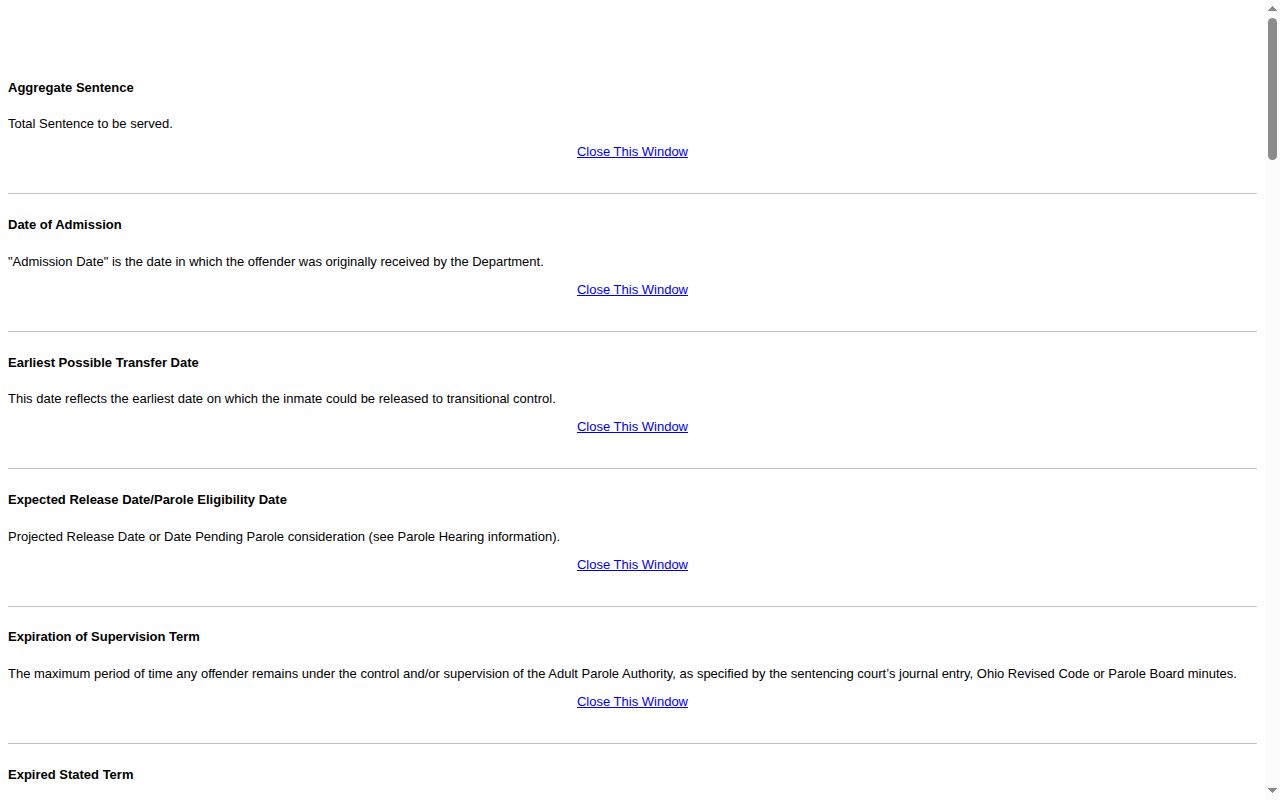
The combined wording is the key caution for Jackson County searches. A date can represent Board eligibility rather than an appointed release day.
The live ODRC form also offers Last Name, First Name, County of Commitment, Residential County, ZIP Code, Status, Next Parole Board Hearing Date, offender Number, and sort order. Last-name searches are prefix based, so a surname can return longer names that begin with the same letters. ODRC advises that fewer criteria can work better than excessive filtering. Residential County and ZIP apply to APA Supervision or Violators at Large and reflect last recorded data, not a verified current address.
Note: County of Commitment identifies the sentence source in ODRC and does not include every former Jackson County jail detainee.
Jackson Release Date Calculation Factors
A displayed ODRC date can reflect the controlling sentence, effective date, jail-time credit, mandatory portions, earned credit, concurrent or consecutive terms, parole eligibility, court orders, and disciplinary changes. Concurrent terms run at the same time to the extent the judgment allows. Consecutive terms run one after another. Jail-time credit is credit ordered or calculated for qualifying prior confinement. A mandatory term is a part the law does not let ordinary earned credit reduce.
Qualifying first- and second-degree indefinite sentences can fall under ORC 2967.271. That law uses minimum and maximum terms and creates a presumption at the minimum that may be rebutted through the statutory process. Old-law and life sentences can involve Board suitability under ORC 2967.13. These frameworks cannot be reduced to one calendar formula.
The court entry supplies the sentence. ODRC applies the state-prison computation. A public field shows the current result, but it may not reveal every internal step. When the date seems inconsistent with the signed judgment, compare the effective date, jail credit, all case numbers, and whether terms were made concurrent or consecutive. Seek an official explanation instead of using an online sentence calculator.
- Expected date
- ODRC's current projected date where applicable, subject to change.
- Parole eligibility
- The first point for Board consideration in an eligible case, not a grant.
- Jail-time credit
- Qualifying prior custody credited toward a sentence.
- Detainer
- A request or hold from another authority that can control the next custody step.
Ohio Earned Credit Is Conditional
ORC 2967.194 is the current earned-credit law for participation beginning April 4, 2024. For eligible people, the statute provides provisional credit of one or five days per completed month depending on the category of productive participation. It can add up to five days for successful completion of a second qualifying program or activity. Certain qualifying completion awards are ninety days or ten percent of the stated prison term, whichever is less.
The ordinary aggregate participation and completion credit described in division (A)(4) is capped at fifteen percent of the stated term. The statute treats specified completion awards separately. Credit is not automatic. It can be denied or withdrawn through conduct review, and the law lists many exclusions. These include mandatory or nonreducible terms controlled elsewhere, murder-related offenses, life without parole, certain special terms, and other named offense categories.
Ohio does not have a universal rule that each prisoner simply serves eighty-five percent. That figure is at most rough shorthand for the inverse of a limited fifteen-percent cap in one eligible earned-credit framework. Mandatory time, excluded offenses, life or old-law parole, indefinite terms, judicial release, jail-time credit, and case-specific orders can produce different outcomes. Applying the shorthand to every Jackson County sentence would be wrong.
Why Jackson Release Dates Change
A projected date is a current calculation based on facts known to the agency. A corrected judgment, new sentence, credit review, discipline, appeal, Board action, or detainer can move the date. Sometimes the public display changes without stating which factor caused the recalculation. Compare the source records before drawing a conclusion.
| Factor | Possible effect | Record to check |
|---|---|---|
| Jail-time credit correction | May move the calculation earlier or later | Sentencing entry and ODRC record |
| Earned-credit award or loss | Can reduce time or restore days to be served | ODRC calculation and applicable statute |
| Concurrent or consecutive correction | Changes how multiple terms combine | Journalized court orders |
| Parole Board action | May grant, continue, deny, or set a projected date | Offender detail and official Board minute |
| Detainer or another hold | May change the next custodian without community release | Jail or agency release record |
| New case or appeal | Can alter the controlling judgment or custody basis | Correct court docket |
For parole matters, a scheduled hearing is not a grant. The ODRC search's Next Parole Board Hearing Date field accepts a month in YYYYMM format, but schedules can change. OAC 5120:1-1-10 addresses projected release dates in official Board minutes. Read the minute for the actual action rather than inferring it from a calendar entry.
Jackson Prison Transfer Is Not Release
The JCCF jail page published by Sheriff Tedd E. Frazier's Jackson County Sheriff's Office states that male offenders transported to prison go to the Correction Reception Center in Orient. That named destination supplies a concrete tracing step after a felony prison commitment. A person leaving JCCF for that reception center has left county custody, but has not been released into the community. Search ODRC after intake rather than reporting the jail departure as release.
The source does not publish the corresponding female intake route, so none should be inferred. Nor should an “earliest out date” on a booking form be treated as the actual date. An authentic Jackson sheriff booking sheet has fields for earliest out date, release date, release time, and released by. Those distinct boxes prove why a forecast and completed event must be kept separate.
The matching official JCCF page captured in the manifest shows the county jail's published prison-transfer information.

When the docket shows a prison commitment, follow the receiving ODRC record. When it shows community control or a release order, confirm physical exit with JCCF.
Confirm Jackson Actual Release Status
After the expected date, search again and read the status. Incarcerated means the date remains prospective. Released is the relevant ODRC prison-status label. APA Supervision means the person is in the state supervision system and is not the same as full discharge. Violators at Large is an absconder status, not an ordinary release outcome.
A pending alert can supplement that check, but Ohio VINE participation and exact JCCF result labels remain unverified. The Jackson County VINELink inmate search explains how to register conditionally and confirm an alert. For a county jail term, call JCCF at 740-288-1338, compare the court order, and request the booking/release record if exact time or transfer status matters.
Jackson County publishes no local jail good-time formula, weekend-release calculation, or explanation of how an earliest-out field is computed. Do not import the state-prison credit formula into that gap. Municipal Court records can supply a misdemeanor sentence and Common Pleas can supply a felony judgment, but JCCF remains the source for its own current local calculation. A court order may set the legal basis while jail staff account for the custody details that apply to the booking.
For a named person, preserve the offender number, exact date label, status, and date checked. A later correction does not mean the earlier screenshot proved actual release. The durable proof is the final agency status combined with the court or release record that documents what occurred.